
Spain Non-Lucrative Visa 2026: the complete guide
TL;DR
- The NLV is a long-stay Spanish visa for non-EU citizens with passive income. It does not permit work in Spain.
- Income threshold 2026: €28,800/year main applicant + €7,200/year per dependent.
- Initial validity: 1 year, renewable 2-year periods indefinitely. Pathway to long-term residence (5 yrs) and citizenship (10 yrs).
- Realistic timeline: 2–6 months from consulate appointment to TIE card in Spain.
- Most common issue at consulates: insufficient income proof. Have 6–12 months of living expenses in a Spanish bank before applying.
NIE service since 2013 · 17 000+ clients handled · 4.9★ on Trustpilot
Facts verified 22 September 2026 against the Ministry of Foreign Affairs visa pages, the Real Decreto 557/2011 (Reglamento de Extranjería), and consulate-specific guidance for Spain's consulates worldwide.
Key facts: NLV at a glance
| Income threshold (2026) | €28,800/year main applicant + €7,200/year per dependent |
|---|---|
| Work allowed? | No |
| Initial validity | 1 year |
| Renewal | 2-year periods indefinitely |
| Pathway | After 5 years → larga duración; after 10 → Spanish citizenship |
| Health insurance | Full Spain coverage, no co-payment, Spanish insurer |
| Where to apply | Spanish consulate in your country of residence |
| Family included | Yes — spouse + minor children |
| Realistic timeline | 2–6 months |
| Cost (realistic first year, couple) | €30,000–€60,000 incl. deposits |
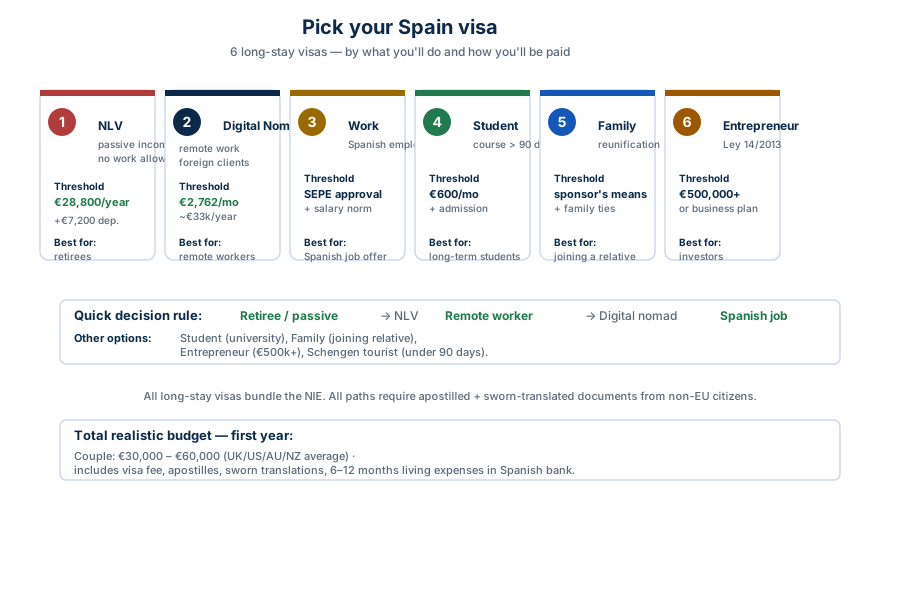
€28,800/year passive income, no work, renewable.
What is the Non-Lucrative Visa?
The Non-Lucrative Visa (NLV) is the most common Spanish long-stay visa for non-EU citizens who want to live in Spain without working. It's also called the "retirement visa" or "passive income visa" in expat English guides, although it isn't restricted to retirees — anyone with a stable passive-income stream qualifies.
You commit to not performing any economic or professional activity in Spain. You can:
- Live in Spain indefinitely
- Open a Spanish bank account
- Buy property
- Register for public healthcare (with social security payments)
- Bring your spouse and minor children
- Travel in and out of Schengen freely
You cannot:
- Work for a Spanish employer or as an autónomo
- Perform any paid activity for Spanish clients
- Receive Spanish income (Social Security benefits from Spain count, though)
If you want to work remotely for foreign clients, consider the Digital Nomad Visa instead. If you want to take a Spanish job, consider the Work Visa. If your income is below the threshold or savings-based, the NLV will be rejected.
Income requirement
2026 figures for the main applicant:
- €28,800/year for the main applicant (4 × IPREM, the Spanish public income indicator)
- €7,200/year for each dependent (1 × IPREM)
What counts as passive income
- Pensions: UK state pension, US Social Security, EU pension fund payments, occupational pensions, QROPS if applicable.
- Rental income: from property in any country (with a valid rental contract).
- Investment income: dividends, interest from savings, capital gains.
- Lump-sum savings: some consulates accept a savings balance held for 6+ months if it generates the equivalent annual income (typically 4% × balance = €28,800).
- Royalty income: from books, intellectual property, patents.
- Family support: in some cases, with notarised proof of dependency.
What does NOT count
- Salary from any employment (active income)
- Income from Spanish clients
- Self-employment income
- Freelance income paid by Spanish companies
- Unofficial or undeclared income
Document checklist
Personal documents
- Valid passport (minimum 1 year validity, 2 blank pages)
- Passport photos (Spanish format: white background, 32×26 mm)
- Criminal record check (countries lived in past 5 years, apostilled, sworn Spanish translation)
- Medical certificate (issued within 90 days of submission, sworn-translated)
Financial documents
- Pension award letters (translated to Spanish if not in Spanish/English)
- Bank statements (last 6 months, all accounts, signed by the bank)
- Investment account statements showing dividend/interest income
- Rental income contracts (notarised or stamped by tax authority)
- Spanish bank certificate showing 6–12 months of living expenses deposited
Health and accommodation
- Health insurance certificate — Spanish insurer, full Spain coverage, no co-payment (Asisa, Adeslas, DKV, Sanitas, IMQ)
- Accommodation proof in Spain — rental contract (≥6 months) or property deed
- Empadronamiento proof (after arrival)
Family dependents (if applicable)
- Marriage certificate (apostilled, sworn Spanish translation)
- Birth certificates for minor children (apostilled, sworn Spanish translation)
- Each dependent's clean criminal record (if 18+)
- Each dependent's health insurance certificate
- Each dependent's passport and photos
Forms and fees
- Spanish visa application form (filled in Spanish, signed)
- Cita previa confirmation at the consulate
- Visa fee (varies by consulate, typically €80–€140)
- €9.84 NIE fee (paid at a Spanish bank once you're in Spain, with Modelo 790 código 012)
Process at a glance
- Open a non-resident Spanish bank account. Some consulates will not accept a savings/investment account only — they want a Spanish deposit with 6–12 months of living expenses.
- Collect apostilled documents. Criminal record check (FBI for US, ACRO for UK), birth/marriage certificates, all apostilled under the Hague Convention of 5 October 1961, plus sworn Spanish translations.
- Buy Spanish health insurance. No co-payment clause, no waiting period, full Spain coverage.
- Book a cita previa at the consulate. Wait time: 2–12 weeks depending on consulate and season.
- Attend the consulate appointment. Bring original documents + copies. Pay the visa fee.
- Wait for visa processing. 4–12 weeks; some consulates email, others post.
- Receive the visa stamp in your passport. The stamp includes your NIE number on it.
- Travel to Spain within the visa validity window (typically 90 days).
- Within 30 days of arrival: apply for the TIE card at the Oficina de Extranjería in your Spanish province. Bring passport, visa stamp, photos, €16.08 TIE fee (Modelo 790 código 012).
- Register for empadronamiento at your local town hall.
Common refusal reasons (and how to avoid them)
- Insufficient income proof. Solution: 6–12 months of living expenses in a Spanish account before you book the cita.
- Health insurance with co-payment or waiting period. Solution: get a Spanish insurer. Asisa, Adeslas, DKV, Sanitas all offer NLV-compliant policies. UK private insurance (BUPA, etc.) usually fails the co-payment test.
- Criminal record not apostilled or sworn-translated. Solution: apostille from the country of issue (FBI for US, ACRO + FCO for UK), then sworn Spanish translation by a MAEC-registered traductor jurado.
- Medical certificate older than 90 days. Solution: get the certificate no more than 30 days before the consulate appointment.
- Accommodation proof insufficient. Solution: a 6-month+ rental contract, a property deed in your name, or a letter from a host + their property deed.
Renewal and pathway to long-term residence
The NLV is renewable every 2 years as long as you still meet the income requirement (€28,800/year in passive income, health insurance, no criminal record in Spain).
After 5 years of legal and continuous residence on the NLV, you can apply for the larga duración long-term residence permit:
- No income requirement anymore (only proof that you can support yourself minimally)
- No need to renew every 2 years — lasts 5 years, renewable
- Right to work freely in Spain (unlike the NLV)
- Same social security access as a Spanish worker
After 10 years of legal and continuous residence (5 on NLV + 5 on larga duración is one common path), you can apply for Spanish citizenship:
- Pass a Spanish language and culture test (DELE A2 minimum)
- Pass a constitutional and sociocultural knowledge test
- Have no criminal record in Spain or countries of prior residence
- Renounce your original citizenship (Spain has dual-citizenship agreements only with a handful of countries, including most Latin American nations, the Philippines, and Andorra)
For non-EU citizens, Spanish citizenship is therefore a major decision because of the renunciation requirement. Many long-term NLV holders stop at the larga duración permit.
Frequently asked questions
What's the income requirement for the Spanish Non-Lucrative Visa?
2026 figures: €28,800/year for the main applicant + €7,200/year per dependent. You prove this with bank statements, pension letters, rental income contracts, or a combination. The income must be passive (no work allowed in Spain).
Can I work with a Non-Lucrative Visa?
No. The NLV explicitly prohibits economic activity in Spain. To work, you need a different visa (digital nomad, work visa, or entrepreneur). You can switch from NLV to a work visa while in Spain.
How long is a Non-Lucrative Visa valid?
Initial validity: 1 year. Renewals: 2-year periods indefinitely. After 5 years of legal and continuous residence, you can apply for the 'larga duración' permit. After 10 years, Spanish citizenship.
Can my family come with me on an NLV?
Yes — your spouse and minor children can apply as dependents. €7,200/year per dependent in addition to the €28,800 base. Each dependent needs their own health insurance and clean criminal record (if 18+).
What counts as proof of passive income?
Pensions (UK state, US Social Security, EU), rental income, dividends and interest, capital gains, royalty income. Salary from work does not qualify.
Do I need to put all the money in a Spanish bank before applying?
Most consulates want to see 6–12 months of living expenses already in a Spanish bank — €14,400–€28,800 for a single applicant. Open a non-resident account at Sabadell, Bankinter, or Openbank.
Can I travel in and out of Spain freely on an NLV?
Yes — you can leave and re-enter Spain as long as your TIE card is valid. Schengen rules cap non-EU stays in other Schengen states at 90/180 days, but Spain allows full re-entry.
Related guides
Sources
- Ministerio de Asuntos Exteriores — visados (visas)
- Real Decreto 557/2011, Art. 41–48 — Reglamentos de Extranjería (NLV procedure)
- Ley 4/2000, Art. 30 bis — derechos y libertades de los extranjeros en España
- IPREM 2026 — Indicador Público de Renta de Efectos Múltiples (€7,200/year base)
- Spanish consular websites — UK, US, Canada, Australia, Russia, China, India
- r/expats and r/GoingToSpain — multiple NLV experience threads (2023–2025)
Reviewed by the Happy Residence S.L. team. Income thresholds, IPREM figures, and procedural details reflect the current state of Spanish law; specific consulates may interpret the rules differently. We re-verify after each regulatory change. We are an administrative assistance service, not a legal advisor or a public administration.