
NIE number in Spain: how to get it (2026 guide)
TL;DR
- A NIE is your Spanish foreign-ID number. It's valid for life, costs €9.84 to apply, and you need it for almost anything serious — buying property, opening a bank account, working, paying tax, getting a phone.
- 5 working days is the legal deadline after the EX-15 is filed. Realistic wait: 1–4 weeks in Spain (including booking the cita) or 4–12 weeks at a consulate.
- Three ways to apply: (1) in person at a Spanish police station; (2) at a Spanish consulate abroad; (3) via a POA representative.
- EU citizens use a NIE + green EU certificate (CUE, €12.00). Non-EU citizens with a residence permit get a NIE + TIE card.
- Want us to handle it? flat fee, 5-day turnaround, no cita wait.
NIE service since 2013 · 17 000+ clients handled · 4.9★ on Trustpilot
Facts verified 22 September 2026 against the Sede Electrónica de la Policía Nacional procedure page and the fee schedule. Procedural details reflect typical practice across Spanish police stations.
Key facts: NIE at a glance
| Official name | Número de Identidad de Extranjero (NIE) |
|---|---|
| Issued by | Spanish National Police (for residents in Spain); Spanish consulates (for applicants abroad) |
| Validity | For life — never expires, never reassigned |
| Application form | EX-15 (Solicitud de Número de Identidad de Extranjero) |
| Fee | €9.84 on Modelo 790 código 012 |
| Legal deadline | 5 working days |
| Realistic wait | 1–4 weeks in Spain (with cita); 4–12 weeks at consulates |
| For non-EU residents | Comes with a TIE card (different document — see renew guide) |
| For EU/EEA citizens | Comes with a CUE certificate (€12.00) — not a TIE |
| For non-resident property owners | NIE only — no TIE needed |
What is a NIE? (full definition)
The NIE — Número de Identidad de Extranjero — is a personal foreign-ID number assigned by Spain to anyone non-Spanish with an economic, professional or social reason to identify themselves to the Spanish state. It's a tax-style alphanumeric identifier (e.g., X-1234567-Z) and is recognised across all Spanish public administrations.
Typical reasons to need a NIE:
- Buying property in Spain (the notary won't proceed without one).
- Opening a Spanish bank account.
- Signing a Spanish employment contract.
- Setting up a Spanish SL or as an autónomo.
- Receiving payments from a Spanish contracting party.
- Signing a rental agreement.
- Filing a Spanish tax return (Modelo 100, 210, etc.).
- Getting a Spanish driving licence conversion.
- Getting a Spanish mobile or utility contract for foreigners.
- Buying a car in Spain.
The NIE is not, by itself, a residence permit. Non-EU/EEA citizens with a residence permit also get a TIE card that holds the NIE. EU/EEA citizens with long-term Spanish ties get a CUE certificate. The NIE number is the same — the surrounding document changes.
Real user framing from Reddit (r/GoingToSpain): people who lost their NIE say "you don't just get a new one, you start a new process" — there's no central retrieval. Keep your EX-15 receipt.
«It's a unique number assigned by the Spanish state for life. Even if you lose the paper, even if you leave Spain for 30 years, the number stays yours.»
— this hub (verified 22 September 2026)
Find your question — routes and subtopics
Each link below is a dedicated guide, written from the same source material as this hub, but focused on one specific question. Pick the one that matches your situation.
| Your question | Where the answer is |
|---|---|
| How much does it actually cost? What's the €9.84 vs a service fee? | NIE cost in Spain: €9.84 fee vs service costs |
| How long does it take — really? | NIE processing time: real timelines |
| Where is my NIE? How do I check status? | NIE status check: where's my number? |
| How to book the cita previa online | Cita previa: how to book a NIE appointment |
| Does NIE expire? What about TIE / CUE? | NIE renewal: TIE vs CUE vs DNI |
| I'm an EU citizen — what changes? | EU Citizens Registration |
| I'm buying property — when do I need the NIE? | NIE number documents and fees |
| All four routes compared | How to get a NIE: four routes compared |
The four routes to a NIE
- Apply in person at a Spanish police station. Book a cita previa at sede.policia.gob.es, bring passport + EX-15 + 790/012 paid + €9.84 receipt, attend your slot. Typically 3–5 weeks total (4-week cita + 5-day resolution).
- Apply at a Spanish consulate. Available only if you live outside Spain. Each consulate has its own system (electronicappointment.maec.gob.es or its own portal). 4–12 weeks total. Documents often need apostille and sworn Spanish translation.
- Apply via POA representative. A representative with a registered power of attorney files on your behalf in Spain. Typically 1–3 weeks total. See applying-from-abroad for full POA workflow.
- Hire a full-service agency (us). One flat fee. We handle every step: cita, EX-15, 790/012 fee, document checks, certificate pickup, scanned copy delivered. Transparent terms.
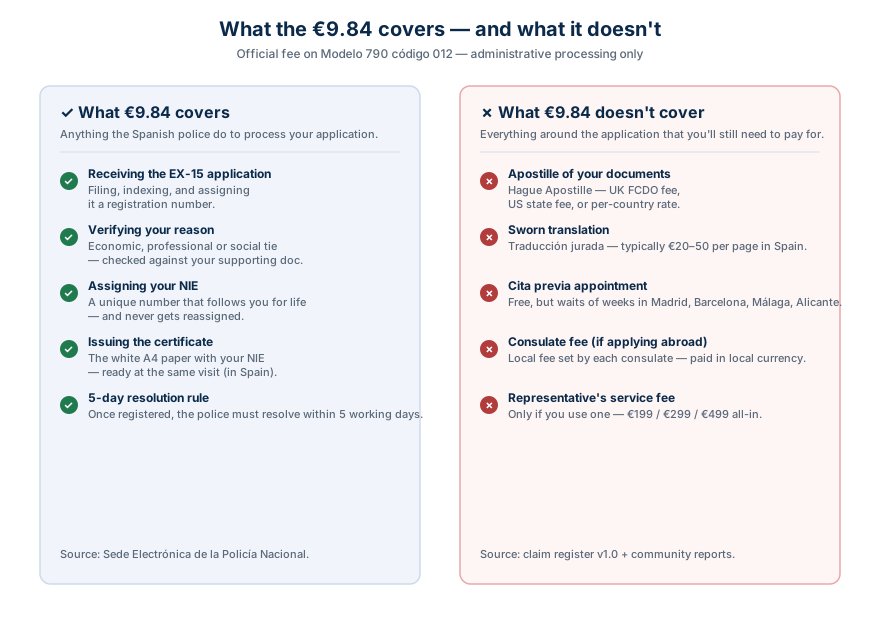
The €9.84 fee (and what you'll pay in total)
| Item | Official fee | Service fee (us) | What it's for |
|---|---|---|---|
| EX-15 application | €9.84 | — | Spanish government processing fee |
| Translation of foreign docs | — | included | Sworn translator if apostille country |
| POA drafting (if used) | — | included | Ley 39/2015 representation |
| Certificate pickup + scan | — | included | We collect it, scan it, mail it |
| Basic service (in Spain, no consulate) | €9.84 | flat fee — quoted up front | All of the above for in-Spain route |
| Premium (priority, status notifications) | €9.84 | flat fee — quoted up front | Same, with status notifications |
| Advance (consulate route) | €9.84 | flat fee — quoted up front | Includes apostille + sworn translation |
Who needs a NIE?
If you have a clear economic, professional or social tie to Spain, you need a NIE. Even visitors on long stays — over 90 days — need one as soon as they're in the padron.
- Property buyers. Spanish notaries refuse a sale without a NIE — the buyer must declare a tax ID. See the cost and forms guide.
- Bank account holders. Most Spanish banks (Santander, BBVA, CaixaBank) require a NIE for non-EU accounts since 2019 FATF guidelines.
- Workers. Required before the first social security / nómina.
- Company owners. Holding 100% of a SL or being an administrador de una sociedad requires a NIE.
- Marrying a Spanish person. The civil registration may require a NIE in the international case.
- Long-term renters. While not strictly required by the Ley de Arrendamientos Urbanos, landlords commonly require a NIE.
- EU retirees. To draw a Spanish pension or get a Spanish health card, you need a NIE.
«Once you've got your NIE, you can do literally anything with Spanish bureaucracy — bank, buy property, register a car, pay tax. Without it, you're stuck in a queue of tired expats.»
— r/expats community sentiment, multiple threads 2023–2025
EU citizens and the EU certificate (CUE)
EU/EEA citizens get a NIE like anyone else, but the residence registration is different. They receive a Certificado de Registro de Ciudadano de la UE (CUE) — the green EU certificate — for €12.00. The CUE is issued alongside the NIE and is the EU equivalent of the non-EU TIE card. Validity: 5 years on first registration, 10 years on renewal. See the EU-citizen registration guide.
Frequently asked questions
What is a NIE number?
A NIE (Número de Identidad de Extranjero) is a personal tax-style ID number for foreigners with economic, professional or social ties to Spain. It's valid for life, never expires, and never gets reassigned.
Do I need a NIE to live in Spain?
Yes — if you have any economic, professional or social connection to Spain. Almost every foreigner who lives, works, invests in, or retires to Spain needs a NIE. The only exception is purely tourist stays (under 90 days, no economic activity).
How long does it take to get a NIE?
5 working days is the legal deadline after the EX-15 is filed at a Spanish police station. Real-life wait is 1–4 weeks including the cita previa to file the EX-15. Applying at a consulate abroad takes 4–12 weeks.
How much does a NIE cost?
€9.84 official fee on Modelo 790 código 012. The fee is identical for all applicants. Agencies set their own handling rates — there's no regulated tariff.
Do EU citizens need a NIE?
Yes. EU/EEA citizens typically use a NIE + green EU certificate (CUE) rather than the TIE card that non-EU/EEA residents get. The NIE part is identical — same form, same fee, same number.
What's the fastest way to get a NIE?
Two paths. (1) Walk to a Spanish police station in person with all documents, file the EX-15 yourself — the legal deadline is 5 working days. (2) Hire a POA representative to file on your behalf — typically 1–3 weeks total.
Can I get a NIE without being in Spain?
Yes — apply at a Spanish consulate in your country of residence. You'll need to file the EX-15 at the consulate, pay the same €9.84 (or sometimes more, in local currency), and wait 4–12 weeks. Documentation depends on the consulate — apostilled birth/marital certificate + sworn Spanish translation are typical.
Related guides
Sources
- Sede Electrónica de la Policía Nacional — Asignación de NIE
- Sede Electrónica de la Policía Nacional — Tasas administrativas
- Real Decreto 557/2011, Art. 206 — Reglamento de Extranjería
- Ley 39/2015, Art. 5 — Poderes de representación administrativa
- r/expats — multiple threads on NIE lost/damaged cases (2023–2025)
- r/Barcelona — in-person experience reports (2023)
Reviewed by the Happy Residence S.L. team. Fees, forms and procedures reflect the current Sede Electrónica documentation and typical police-station practice; specific offices may interpret the rules differently. We re-verify after each regulatory change. We are an administrative assistance service, not a public administration.