
Moving to Spain from the UK in 2026: the full relocation playbook
TL;DR
- UK citizens are non-EU for immigration purposes since 2021. You need a visa for any stay over 90 days.
- Most common routes: non-lucrative visa (passive income), digital nomad visa (remote work), work visa (Spanish employer), student visa.
- Plan 3–6 months: visa 4–12 weeks, NIE bundled with the visa or applied within 1–4 weeks after arrival, bank account 2–6 weeks after NIE.
- You need €28 800/year for the non-lucrative visa, or €2 762/month for the digital nomad visa (2026 figures).
- First-year realistic budget for a couple: €30 000–€60 000 including deposits, setup, and a 3-month buffer.
NIE service since 2013 · 17 000+ clients handled · 4.9★ on Trustpilot
Facts verified 22 September 2026 against the Spanish Consulate London procedures, the Ley de Startups (digital nomad visa), and HMRC guidance on moving abroad.
Key facts: UK to Spain at a glance
| Visa required | Yes, for stays over 90 days since 2021 |
|---|---|
| Most common long-stay visa | Non-lucrative (NLV) for retirees and passive-income movers |
| NLV income requirement | €28 800/year main applicant (2026) |
| Digital nomad visa income | €2 762/month (Law 28/2022) |
| Where to apply | Spanish consulate in London, Edinburgh, Manchester, or Dublin (if you live in Ireland) |
| NIE bundled? | Yes — with every long-stay visa application |
| Health cover requirement | Private health insurance with full Spain coverage |
| UK state pension in Spain | Continues; taxable in Spain as foreign income |
| Realistic first-year budget (couple) | €30 000–€60 000 including deposits |
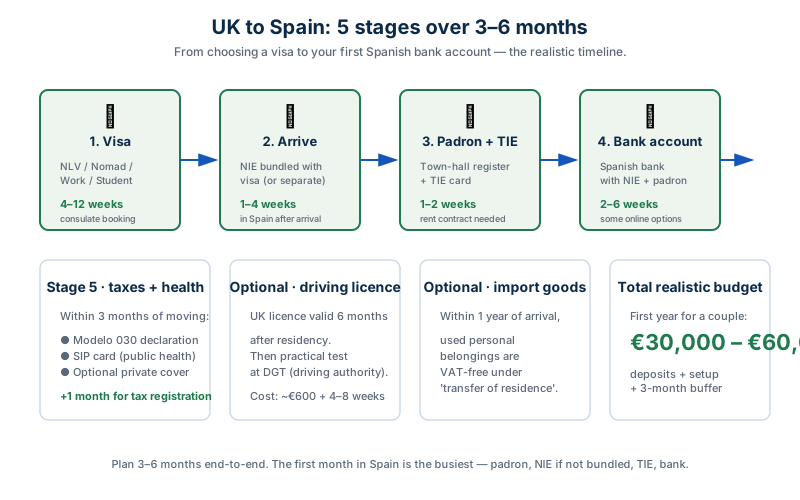
Stage 1 — Choose your visa (4–12 weeks)
After Brexit, UK citizens fall into the same immigration category as US, Canadian, Australian, Russian, Chinese and most other non-EU nationals. The visa you need depends on what you'll do in Spain.
1a. Non-lucrative visa (NLV) — for retirees and passive income
Most common for UK movers aged 50+ with a UK state pension, rental income, savings, or investment income. You commit to not work in Spain (passive income only). Requirements: €28 800/year main applicant, plus €7 200/year per dependent (2026 figures — confirm at the consulate at submission).
1b. Digital nomad visa — for remote workers (since 2023)
For employees of non-Spanish companies or freelancers working with non-Spanish clients. Salary or income threshold: €2 762/month (about €33 144/year). Valid up to 1 year, renewable up to 5 years. Requires a clean criminal record from countries you've lived in the past 5 years.
1c. Work visa tied to a Spanish employer
You have a Spanish job offer with a contract that's been pre-approved by the Spanish public employment service (SEPE). Less common for first-time movers; usually used when a Spanish company recruits you specifically.
1d. Student visa
You have admission to a Spanish university or accredited course longer than 90 days. Income proof: €600/month minimum.
1e. Family reunification
You're joining a family member (Spanish citizen or EU citizen with valid residence in Spain) already lawfully resident.
For most UK movers, the choice is between NLV (passive income) and digital nomad visa (remote work). Each consulate treats them slightly differently — book a pre-application chat at the consulate before submitting.
Stage 2 — Apply at the Spanish consulate
UK residents apply at one of the four Spanish consulates in the UK:
- London — 20 Park Crescent, W1B 1AL. By appointment only, typically 4–8 weeks wait.
- Edinburgh — 63 North Castle Street, EH2 3LJ. Faster: 2–4 weeks.
- Manchester — 1 Chester Street, M2 4JD. Wait: 2–4 weeks.
- Dublin — 17A Russell Court, St Stephen's Green, Dublin 2. Wait: 2–6 weeks.
What to bring to the consulate
- Passport (original + copy; valid for at least 1 year, 2 blank pages)
- Visa application form (filled in Spanish, signed)
- Proof of income (payslips, pension letters, bank statements for the last 6 months)
- Private health insurance certificate (with full Spain coverage, no co-payment, no waiting period)
- Criminal record check (ACRO police certificate from UK, apostilled, sworn translation)
- Medical certificate (issued within 90 days of submission)
- Proof of accommodation in Spain (rental contract, property deed, or letter from host)
- Passport photos (Spanish format, white background)
The consulate issues the visa in 4–12 weeks. You receive a sticker in your passport + the NIE (yes, bundled).
Stage 3 — Arrive in Spain and register (1–2 weeks)
Within 30 days of arrival you must:
- Get the TIE card (if you hold a residence visa). Book a cita previa at the Oficina de Extranjería in your Spanish province. Bring passport, visa stamp, photos, the TIE fee (€16.08 first issue). Fingerprints taken on the day.
- Register for empadronamiento at the local town hall (ayuntamiento). You need a rental contract or property deed plus your passport. This gives you a volante de empadronamiento — proof of address that banks, the health system, and schools require.
- Get your SIP card (CatSalut / Tarjeta Sanitaria Individual). Your health-system registration. Issued at your local Centro de Salud once you have the empadronamiento.
- Apply for the NIE if you didn't get it with the visa. Some visa categories bundle the NIE, some don't. If yours didn't, file EX-15 at the nearest police station with cita previa.
Stage 4 — Open a Spanish bank account (2–6 weeks)
Banks in Spain require: NIE + passport + empadronamiento + proof of income (payslip, pension letter, or Modelo 100 for self-employed). Most traditional banks want personal presence to open the account. Some non-resident-friendly options:
- Sabadell — non-resident account available before arrival with NIE + foreign address.
- Bankinter — non-resident account with NIE + utility bill or rental contract.
- Openbank (Santander) — fully digital account, NIE + video ID sufficient.
- MyInvestor — digital, no fees, NIE + Spanish address proof.
Document checklist for bank account:
- Original passport + NIE certificate
- Empadronamiento (certificado de empadronamiento)
- NIE number (you'll need it for everything — keep the paper safe)
- Proof of income or Modelo 100 (last tax return) for self-employed
- €0–€100 typical opening deposit (varies by bank)
Stage 5 — Taxes, healthcare, and the rest of the first year
Tax registration (Modelo 030)
Foreign residents must file a declaración censal (Modelo 030) within 3 months of moving. This is the Spanish equivalent of telling HMRC you've moved abroad. It assigns your tax residency and triggers obligations to file Modelo 100 (income tax) annually if you earn above the personal allowance.
Healthcare via the public system
Once you have the SIP card and you pay into the Spanish social security system (or hold a pension), you access the public healthcare system. Most UK expats use private cover alongside — the public system is excellent but slower for non-urgent care. Sanitas, Adeslas, and DKV are the main private options; expect €50–€150/month for a couple in their 50s.
Driving licence
UK driving licences are valid for 6 months after you become resident. After that, you either exchange it (UK licences are not directly exchangeable since Brexit — you need a practical test) or sit the Spanish exam. Process is via the Dirección General de Tráfico (DGT).
Importing your belongings
Personal belongings used for at least 6 months can be imported duty-free under the "transfer of residence" relief, but you must declare within 1 year. Form Modelo 036 + inventario.
Real-life mistakes we see every month
- Applying for the tourist visa when they want the long-stay one. Schengen tourist visa = 90 days max, no extension. For longer stays you need a long-stay visa, applied for at the Spanish consulate in your home country.
- Not getting health insurance with no co-payment clause. The consulate rejects policies with co-payment (copago). Buy from a Spanish insurer, not a UK broker.
- Not apostilling the criminal record check. It needs UK ACRO police certificate + Hague apostille + sworn translation. No apostille = visa denied.
- Bringing furniture without declaring it. If you import belongings after the 1-year window, they become taxable at standard VAT (21%).
- Forgetting the 183-day rule. If you spend more than 183 days in Spain in a calendar year, you're tax resident. The UK stops treating you as UK-resident for tax purposes — both countries could claim you. Plan accordingly.
Frequently asked questions
Do UK citizens need a visa to move to Spain after Brexit?
Yes. UK citizens are treated as non-EU/EEA for immigration purposes since January 2021. For stays under 90 days you don't need a visa (only the passport). For longer stays you need either a long-stay visa (work, non-lucrative, student, family reunification) or a residence permit pathway. The NIE is required for all economic activity.
What's the easiest way to get a Spanish visa from the UK?
For retirees or people with passive income: the non-lucrative visa (NLV). For remote workers: the digital nomad visa (Law 28/2022, in force since January 2023). For workers with a Spanish employer: the work visa tied to a job offer. For students: student visa with admission letter. The NLV is the most common for UK movers aged 50+ who can show €28 800/year passive income.
How long does the whole process take — visa + NIE + bank account?
Plan 3–6 months. Long-stay visa: 4–12 weeks from consulate submission. NIE: bundled with the visa or applied separately within 1–4 weeks after arrival. Spanish bank account: 2–6 weeks after NIE. Padron municipal: 1–2 weeks after rental contract.
Can I open a Spanish bank account before I move to Spain?
Yes — some banks (Sabadell, Bankinter, certain digital banks) open accounts for non-residents with a passport + NIE + proof of Spanish address (or a foreign address through their non-resident pathway). Most traditional banks require personal presence in Spain for the first account.
Do I need the NIE before or after I get the visa?
If you apply at a Spanish consulate, the NIE is bundled with the long-stay visa — you receive both at the same time. If you apply for a non-lucrative visa first and then move to Spain, the NIE is part of the visa application. If you arrive on a tourist visa and then decide to stay, you apply for the NIE at the nearest police station within your first 90 days.
What happens to my UK pension when I move to Spain?
It continues — UK state pension is paid regardless of where you live, including Spain. The amount freezes at the point you start drawing it (no inflation indexation after Brexit). Private UK pensions are typically unfrozen and can be transferred to a QROPS or left in the UK. UK pension income is taxable in Spain as foreign income — you must file a Spanish tax return (Modelo 100) each year if you live there more than 183 days a year.
How much money do I need to move to Spain from the UK?
Depends on the route. Non-lucrative visa: €28 800/year passive income (2026 figure). Digital nomad visa: €2 762/month or €33 144/year. Work visa: tied to a Spanish employer's offer. Lump-sum savings: most consulates want 6–12 months of living expenses. Realistic first-year budget for a couple: €30 000–€60 000 including deposits, setup, and a buffer.
Related guides
Sources
- Spanish Consulate London — visas and procedures
- Ley 28/2022, de 21 de diciembre, de Startups — digital nomad visa
- HMRC — tax on UK pensions when living abroad
- UK ACRO — Police Certificate (criminal record check)
- Agencia Tributaria — Modelo 030 declaration of censal
- Tesorería General de la Seguridad Social — SIP card and social security
- r/GoingToSpain — multiple personal relocation experience threads (2023–2025)
- r/expats — UK-Spain pension and banking threads (2023–2025)
Reviewed by the Happy Residence S.L. team. Visa thresholds, fees and timelines reflect the current consulate procedures and law; specific consulates may interpret the rules differently. We re-verify after each regulatory change. We are an administrative assistance service, not a public administration.