
Spain visa guide 2026: every long-stay visa for foreigners
TL;DR
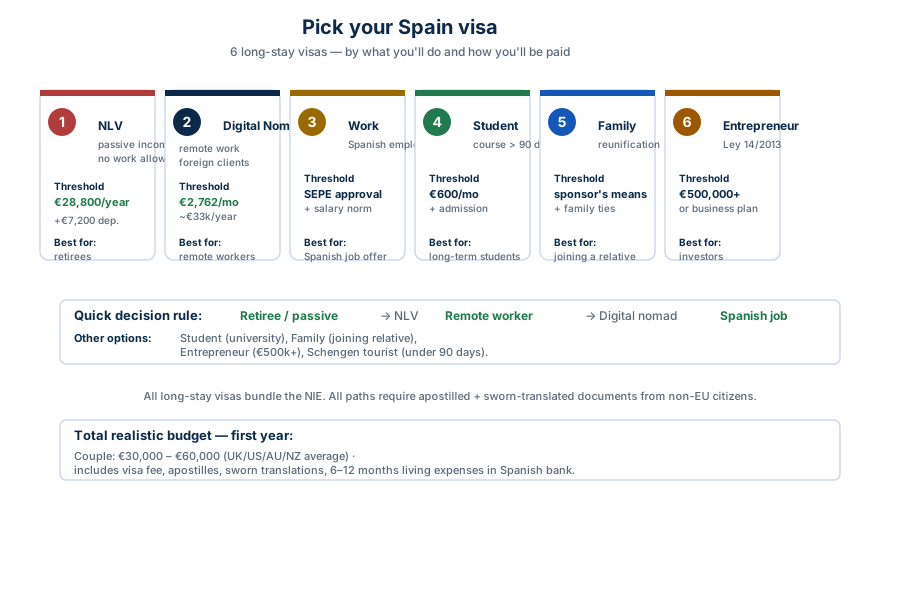
- Six long-stay visa types: NLV (passive income), digital nomad (remote work), work (Spanish employer), student, family reunification, entrepreneur.
- NLV income threshold: €28 800/year main applicant (2026). Plus €7 200/year per dependent.
- Digital nomad income threshold: €2 762/month (about €33 144/year).
- All long-stay visas bundle the NIE — you get the Spanish tax ID number with the visa stamp.
- Total realistic timeline: 1–4 months: consulate wait 2–12 weeks + visa processing 4–12 weeks.
NIE service since 2013 · 17 000+ clients handled · 4.9★ on Trustpilot
Facts verified 22 September 2026 against the Ministry of Foreign Affairs visa pages, Ley 14/2013 (entrepreneur visa), Ley 28/2022 (digital nomad visa), and Real Decreto 557/2011.
Key facts: all six long-stay visas at a glance
| Visa | Income threshold | Best for | Work allowed? | Length |
|---|---|---|---|---|
| Non-lucrative (NLV) | €28 800/year | Retirees, passive-income movers | No | 1 year + 2-year renewals |
| Digital nomad | €2 762/month | Remote employees, freelancers with foreign clients | Yes (foreign clients) | 1 year + up to 5 years |
| Work visa | Tied to Spanish employer offer | People with a Spanish job offer | Yes (specified job) | 1 year + 2-year renewals |
| Student | €600/month | Long-term students at accredited institutions | Part-time only | Course length |
| Family reunification | Sufficient means test | Joining family member resident in Spain | Same as sponsor | Tied to sponsor's permit |
| Entrepreneur | Business plan + investment | Founders, investors, intra-EU transfers | Yes (own business) | 1 year + 2-year renewals |
Non-lucrative visa (NLV) — for retirees and passive income
Spain's most common long-stay visa for non-EU citizens with passive income. You commit to not working in Spain but you can live there indefinitely. Income sources accepted:
- UK state pension (post-Brexit UK is non-EU again)
- US Social Security + IRA/401(k) distributions
- Rental income from property in any country
- Dividends, savings interest, capital gains
- Family support (proof of dependency required)
Requirements (2026)
- Income: €28 800/year main applicant + €7 200/year per dependent.
- Funds in Spanish bank: most consulates want to see 6–12 months of living expenses already deposited.
- Health insurance: full Spain coverage with a Spanish insurer, no co-payment, no waiting period.
- Criminal record: clean record from countries lived in the past 5 years, apostilled, sworn translation.
- Medical certificate: issued within 90 days of submission.
- Accommodation: rental contract, property deed, or letter from host.
Renewal and pathway to long-term residence
The NLV is initially valid 1 year, renewable for 2-year periods indefinitely. After 5 years of legal and continuous residence, you can apply for the larga duración long-term residence permit (5 years) and then Spanish citizenship after 10 years (with caveats for non-EU).
Digital nomad visa — since 2023
Law 28/2022 introduced the digital nomad visa. Open to non-EU citizens who work remotely for non-Spanish companies or as freelancers with mostly international clients.
Requirements (2026)
- Income: €2 762/month minimum (about €33 144/year).
- Employment: contract with a non-Spanish company OR a freelance relationship with mostly non-Spanish clients. Self-employed in Spain is also possible via the autónomo pathway.
- Clean criminal record from any country lived in the past 5 years.
- Health insurance with full Spain coverage.
Length and benefits
Initial visa up to 1 year, renewable up to 5 years. The permit can be extended further via the regular Spanish residence permits. Spouse and minor children can join under family reunification rules. If you take a Spanish employer, you can switch to a work visa without leaving Spain.
Work visa tied to a Spanish employer
You have a Spanish job offer from a Spanish employer. The employer must have the position pre-approved by the SEPE (Servicio Público de Empleo Estatal). The contract must meet minimum salary thresholds by occupation. Less common for first-time foreign movers — usually used when a Spanish company specifically recruits you.
When this is the right route
- A Spanish employer offered you a permanent or year-long contract.
- You're transferring within a multinational to a Spanish office (intra-company transfer).
- You're a highly-skilled professional under EU Blue Card rules.
Student visa
You're enrolled at a Spanish university (undergraduate, master, PhD) or an accredited language school for more than 90 days. Income: €600/month minimum.
Part-time work (up to 30 hours/week) is allowed during your studies. After graduation, you can switch to a work visa if you have an offer, or you can apply for a job-search visa in some cases.
Family reunification visa
You're joining a family member (Spanish citizen, EU citizen lawfully resident in Spain, or non-EU citizen holding a long-stay visa) already living in Spain.
The sponsor must demonstrate sufficient income and accommodation to support the family. Once granted, the family member can work without restriction.
Entrepreneur visa (Ley 14/2013)
For founders, investors, and intra-company transfers. Requires a credible business plan and either:
- An investment of at least €500,000 in Spanish real estate or business.
- A business project of general interest (job creation, innovation, social impact).
- An entrepreneurial activity evaluated as innovative (with a report from ENISA or similar).
- A capital investment of €1M+ in Spanish Treasury bonds or shares of Spanish companies.
Pick your visa by situation
- Retired with passive income? → NLV.
- Remote worker earning above €2 762/month? → Digital nomad visa.
- Have a Spanish employer offer? → Work visa.
- Coming to study more than 90 days? → Student visa.
- Family of a Spanish resident? → Family reunification.
- Investing €500 000+ in Spain? → Entrepreneur / investor visa.
Common mistakes across all Spain visas
- Applying with insufficient income proof. Consulates look at bank statements, not at salary promises. Make sure you have 6–12 months of living expenses in a Spanish bank before applying.
- Health insurance with co-payment. The consulate rejects any policy with copago or with a waiting period. Buy from a Spanish insurer.
- Missing apostille on criminal record. Apostille + sworn Spanish translation is required for most non-EU applicants.
- Forgetting health-insurance proof for dependents. If you bring family, each member needs the same full Spain coverage.
Frequently asked questions
Which Spanish visa do I need as a non-EU citizen?
Depends on what you'll do. For passive income / retirement: Non-lucrative Visa (NLV, €28 800/year). For remote work: Digital Nomad Visa (€2 762/month). For a Spanish employer: Work Visa. For study: Student Visa. For family ties: Family Reunification. For business investment: Entrepreneur Visa. Tourist stays under 90 days: Schengen Visa.
What's the cheapest Spain visa for non-EU citizens?
The Schengen tourist visa (free for many passports, including US, UK, Canada, Australia, Japan). For long stays, the digital nomad visa has the lowest barrier for employed remote workers (€2 762/month income).
Can I work in Spain with a tourist visa?
No. Tourist Schengen visas prohibit any economic activity — including freelance work, paid content creation, or consulting. For remote work paid by non-Spanish clients, you need a Digital Nomad Visa.
How long does it take to get a Spanish long-stay visa?
Plan 1–4 months total. Consulate appointment wait: 2–12 weeks. Visa processing: 4–12 weeks. The NIE is bundled with the visa.
Can I switch visa types while in Spain?
Yes. You can switch from a Student Visa to a Work Visa, from a Digital Nomad Visa to a Work Visa, from a NLV to a Work Visa. Apply for a 'modificación de la autorización' at the Oficina de Extranjería.
Do I need a visa to buy property in Spain?
No — but you need a NIE. A NIE is your Spanish tax ID for foreigners. You can buy property on a tourist visa, on a longer-stay visa, or even before moving at all.
Which visa is best for a US retiree moving to Spain?
The Non-Lucrative Visa (NLV). You commit to not working in Spain. €28 800/year passive income, full Spain-coverage health insurance, clean criminal record, accommodation proof.
Related guides
Sources
- Ministerio de Asuntos Exteriores — tipos de visados
- Ley 28/2022, de 21 de diciembre, de Startups — digital nomad visa
- Ley 14/2013, de 27 de septiembre, de apoyo a los emprendedores y su internacionalización — entrepreneur visa
- Real Decreto 557/2011 — Reglamento de Extranjería
- r/expats — multiple visa experience threads (2023–2025)
Reviewed by the Happy Residence S.L. team. Income thresholds and procedure timings reflect the current state of Spanish law; specific consulates may interpret the rules differently. We re-verify after each regulatory change. We are an administrative assistance service, not a legal advisor or a public administration.