
Moving to Spain from the USA in 2026: the American playbook
TL;DR
- US citizens are non-EU for Spanish immigration. You need a long-stay visa for any stay over 90 days.
- Most common routes: non-lucrative visa (NLV) for retirees and passive-income movers, digital nomad visa for remote workers, work visa for Spanish employees, student visa.
- Plan 4–7 months: consulate wait 2–12 weeks, visa 4–12 weeks, NIE bundled, bank 2–6 weeks.
- Income thresholds (2026): NLV €28 800/year, digital nomad €2 762/month.
- Taxes: you remain a US taxpayer (FBAR, Form 1040, possible FEIE). Spain taxes you as resident if you live there 183+ days. Tax treaty prevents double taxation, but file on both sides with expert advice.
NIE service since 2013 · 17 000+ clients handled · 4.9★ on Trustpilot
Facts verified 22 September 2026 against the US Embassy Spain, the Ley de Startups (digital nomad visa), and IRS guidance on moving abroad.
Key facts: US to Spain at a glance
| Visa required for stays over 90 days | Yes, for US citizens |
|---|---|
| Most common long-stay visa | Non-lucrative (NLV) for passive income |
| NLV income requirement | €28 800/year main applicant (2026) |
| Digital nomad visa income | €2 762/month (about €33 144/year) |
| Where to apply | Spanish consulate in Washington DC, NY, Chicago, Houston, LA, SF, Boston, or Miami |
| US taxes continue? | Yes — you remain US tax resident worldwide |
| Spain taxes apply | Yes if you live there 183+ days/year |
| Realistic first-year budget (couple) | €35 000–€70 000 including deposits |
| Driving licence timeline | 6 months then practical test through DGT |
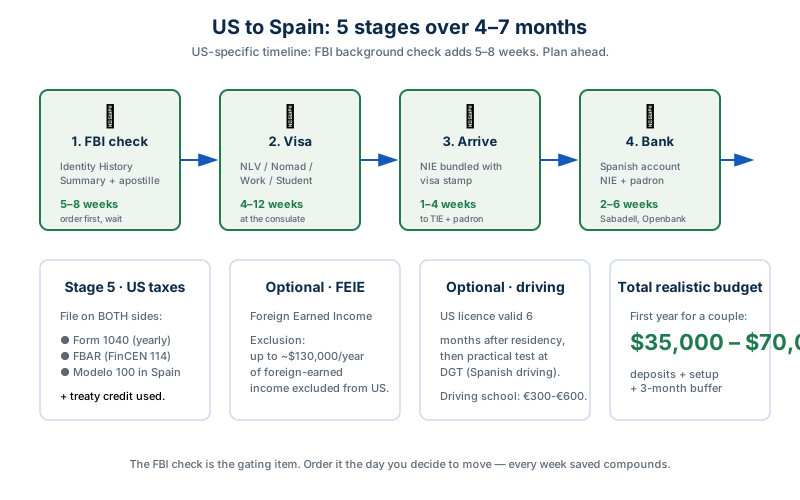
Stage 1 — Choose your visa (4–14 weeks)
American expats in Spain typically enter via one of four visa tracks. The choice depends on what you'll do in Spain and how you'll support yourself.
1a. Non-lucrative visa (NLV) — the default for American retirees
The most common route for US retirees and Americans with passive income. You must commit to not working in Spain, but you can live there indefinitely. Income sources accepted: US Social Security, IRA distributions, 401(k) withdrawals, dividends, rental income from US properties, savings. The main applicant needs €28 800/year in passive income; each dependent adds €7 200/year. Health insurance: full Spain coverage with no co-payment.
1b. Digital nomad visa — for remote workers (since 2023)
Open to Americans who work remotely for US companies or as freelancers with mostly US/international clients. Salary or income: €2 762/month (about €33 144/year). Requires an FBI criminal background check (apostilled, sworn-translated to Spanish), a clean record from any country you've lived in for the past 5 years, and a contract or portfolio of clients that demonstrates foreign work. Valid up to 1 year, renewable up to 5 years.
1c. Work visa tied to a Spanish employer
You have a Spanish job offer with a contract pre-approved by the SEPE (Spanish public employment service). Less common for first-time expats, but useful for people recruited by Spanish companies.
1d. Student visa
You're enrolled at a Spanish university or accredited language school for more than 90 days. Income: €600/month minimum.
Stage 2 — Apply at the Spanish consulate
US residents apply at one of the eight Spanish consulates in the US:
- Washington DC — main consulate, often the longest wait (8–12 weeks for visa)
- New York — high demand
- Chicago — mid-range
- Houston — fast
- Los Angeles — high demand
- San Francisco — mid-range
- Boston — fast
- Miami — fast
US-specific document checklist
- Passport (original + copy, valid for 1 year, 2 blank pages)
- Visa application form (in Spanish, signed)
- FBI Identity History Summary (criminal record check, apostilled, sworn Spanish translation) — this is what most US visa applications get stuck on for weeks
- IRS transcripts or US tax returns (last 3 years) showing source of income
- Social Security Award Letter (if claiming Social Security as income)
- Bank statements (last 6 months)
- Private health insurance certificate (full Spain coverage, no co-payment, Spanish insurer)
- Medical certificate (within 90 days of submission)
- Proof of accommodation in Spain (rental contract or hotel booking initially)
- Passport photos (Spanish format)
- US residency proof (US visa or green card — non-citizens may need additional apostilled documents)
The FBI background check is the single biggest timing variable: standard processing is 8–12 weeks, expedited at $45/identity is 5 business days. Some consulates won't open the file until you have the apostilled FBI check, so order it immediately after deciding to apply.
Stage 3 — Arrive in Spain (1–4 weeks)
Within 30 days of arrival:
- Apply for the TIE card if you hold a residence visa (work, NLV, etc.). Book cita previa at the Oficina de Extranjería in your Spanish province. Bring passport, visa, photos, fee (€16.08 first issue). Fingerprints taken on the day.
- Register for empadronamiento at your local town hall (ayuntamiento). Required documents: rental contract or property deed plus passport. You'll get a volante de empadronamiento — proof of address for banks, public health, schools.
- Apply for the SIP card (CatSalut / Tarjeta Sanitaria Individual) at your local Centro de Salud. Issued within weeks of having the empadronamiento.
- Confirm your NIE is in your passport. If you applied at a US consulate, the NIE is bundled with the visa. If not, apply separately at the nearest police station with cita previa (1–4 weeks).
Stage 4 — Spanish bank account (2–6 weeks)
Banks in Spain require: NIE + passport + empadronamiento + proof of income (US tax returns, W-2, 1099, Social Security letter) + Spanish rental or property deed. Personal presence is usually required for the first account.
- Sabadell — non-resident friendly, English support, no fees first year, integrates with US wires.
- Bankinter — non-resident account, US tax form W-8BEN submitted.
- Openbank (Santander) — fully digital, English app, no fees, NIE + video ID sufficient.
- Wise or Revolut — multi-currency with Spanish IBAN. Useful for paying Spanish bills and receiving US transfers cheaply.
If you have a US LLC or sole proprietorship, ask the bank about business banking — most Spanish banks offer business accounts with NIE + US EIN equivalent (NIF for the entity).
Stage 5 — US-Spain tax planning (year-round)
This is the biggest difference between a UK and US move. The US taxes citizens on worldwide income regardless of where they live. The US-Spain tax treaty (form 1040 + Modelo 100) prevents double taxation through credits, but you file both.
Federal: Form 1040 + FBAR
- Form 1040 — yearly US income tax return on worldwide income.
- FBAR (FinCEN 114) — yearly report on foreign financial accounts >$10k.
- Form 8938 (FATCA) — additional disclosure on specified foreign financial assets.
Foreign Earned Income Exclusion (FEIE)
You can exclude up to ~$130,000 of foreign-earned income per year from US tax if you meet the physical presence test (330 days outside the US in a 12-month period) or the bona fide residence test. Note: the FEIE doesn't apply to unearned income (Social Security, IRA distributions, dividends).
Spain: Modelo 100 + NIE registration
After Modelo 030 (tax registration) and once tax resident, you file Modelo 100 yearly. Spain generally has higher tax rates than the US for high earners, so the US tax you pay is usually zero (the foreign tax credit wipes out the US liability). But you still file.
The experts to hire
Use a dual-qualified tax advisor (US CPA with Spanish expertise, or a Spanish gestor with US clients). Expect €500–€2,000 per year. Worth it — mistakes on either side trigger audits.
Frequently asked questions
Do US citizens need a visa to move to Spain?
Yes, for stays over 90 days. US citizens fall in the same immigration category as UK, Russian, and most other non-EU nationals under current Spanish law. The NIE is required for all economic activity.
Which Spanish visa is best for a US citizen who wants to retire in Spain?
The non-lucrative visa (NLV) is the most common. €28 800/year passive income (2026 figure) plus €7 200/year per dependent. Health insurance with full Spain coverage, no co-payment.
Can a US citizen get a digital nomad visa for Spain?
Yes — Spain's digital nomad visa (Law 28/2022) is open to Americans. Income: €2 762/month minimum. Requires a clean criminal record from any country lived in for the past 5 years, an FBI check, and a job with non-Spanish clients.
How long does the US-to-Spain relocation take?
Plan 4–7 months. Consulate appointment wait: 2–12 weeks. Visa processing: 4–12 weeks after submission. NIE: bundled or 1–4 weeks after arrival. Bank account: 2–6 weeks after NIE.
Will my US tax obligations follow me to Spain?
Yes — US citizens are taxed on worldwide income regardless of where they live. Spain also taxes you as resident if 183+ days. The US-Spain tax treaty prevents double taxation, but you must file carefully on both sides. FEIE lets you exclude up to ~$130,000 of foreign-earned income from US tax.
What Spanish bank account do US citizens usually open?
Most US movers use Sabadell (non-resident friendly, English support), Bankinter (non-resident account), Openbank (digital, English app), or Wise/Revolut (multi-currency IBAN). Documents: passport, NIE, empadronamiento, proof of US income.
Do I need to get a Spanish driving licence if I move from the US?
Yes, after 6 months. US licences are not directly exchangeable. You must take a practical test at the DGT. Many expats take a driving school (€300–€600) before the test.
Related guides
Sources
- Spanish Consulates in the US — visa procedures
- US Embassy in Spain — services for US citizens abroad
- Ley 28/2022, de 21 de diciembre, de Startups — digital nomad visa
- IRS — taxpayers living abroad
- FBI Identity History Summary — how to request
- US-Spain Tax Treaty — Convention for the Avoidance of Double Taxation
- Spain Modelo 030 — declaration of censal (tax registration)
- r/expats — multiple US-to-Spain relocation threads (2023–2025)
Reviewed by the Happy Residence S.L. team. Visa thresholds, fee schedules and consulate processes reflect the current state of the law; specific consulates interpret the rules differently. US tax thresholds and forms are subject to annual adjustment. We re-verify after each regulatory change. We are an administrative assistance service, not a public administration, and we do not provide tax advice — consult a dual-qualified US/Spanish advisor for tax questions.