
NIE documents, forms and the official fee
TL;DR
- A complete NIE application is three things: form EX-15 signed in two copies, the €9.84 fee stamped on Modelo 790 código 012 by a Spanish bank, and your passport + documentary proof of why you need the number.
- The fee is paid before submission, at a banco colaborador, under the concept "Asignación de NIE a instancia del interesado".
- Same 790/012 form has other concepts (TIE €16.08 / TIE renewal €19.30 / EU cert €12.00). Wrong concept = rejected application.
- No empadronamiento required. A foreign address is fine for notifications.
- Documents issued abroad need an apostille (Hague 1961) and, where not in Spanish, a sworn translation by an MAEC-registered traductor jurado.
NIE service since 2013 · 17 000+ clients handled · 4.9★ on Trustpilot
Facts verified 22 September 2026 against the Sede Electrónica de la Policía Nacional and the official fee schedule.
Key facts: what a complete application contains
| Application form | EX-15 (Solicitud de NIE y Certificados) |
|---|---|
| Fee form | Modelo 790 código 012 |
| Fee concept (exact wording) | "Asignación de Número de Identidad de Extranjero (NIE) a instancia del interesado" |
| Fee amount | €9.84 |
| Proof of payment | Stamped form from a banco colaborador |
| Passport | Original + full copy, every page including blanks |
| Reason (motivo) | Economic, professional or social — with one supporting document |
| Foreign documents | Apostille (Hague 1961) + sworn Spanish translation |
| Empadronamiento | Not required |
| Spanish address | Not required |
| Personal presence | Not required if you appoint a POA representative (Ley 39/2015) |
Form EX-15, field by field
EX-15 is a two-page form; the fields that decide the outcome are a handful. Fill it in Spanish, in capital letters or typed, and sign both copies.
- Section 1 — Datos del interesado. Your details exactly as in your passport: surname(s), first name, date and place of birth, nationality, passport number. Mismatched transliteration between the form and the passport is the most common correction request.
- Section 2 — Datos del representante. Only if someone applies on your behalf under Ley 39/2015. Left blank when you apply in person.
- Domicilio a efectos de notificaciones. The address where the administration can reach you. An address outside Spain is acceptable — do not invent a Spanish one; an address you cannot receive mail at is how notifications get lost.
- Section 4 — the checkboxes. Tick NIE (not "Certificados"), and under Motivos tick one of económicos, profesionales or sociales — the same category your supporting document proves. A ticked box with no matching document is a refusal waiting to happen.
- Date and signature. Undated and unsigned second copies are the second most common correction request. Both copies need both.
Frequent errors, in order of frequency: fee paid on the wrong concept, motivo ticked but not documented, address that cannot receive notifications, second copy unsigned.
Modelo 790 código 012 — paying the €9.84
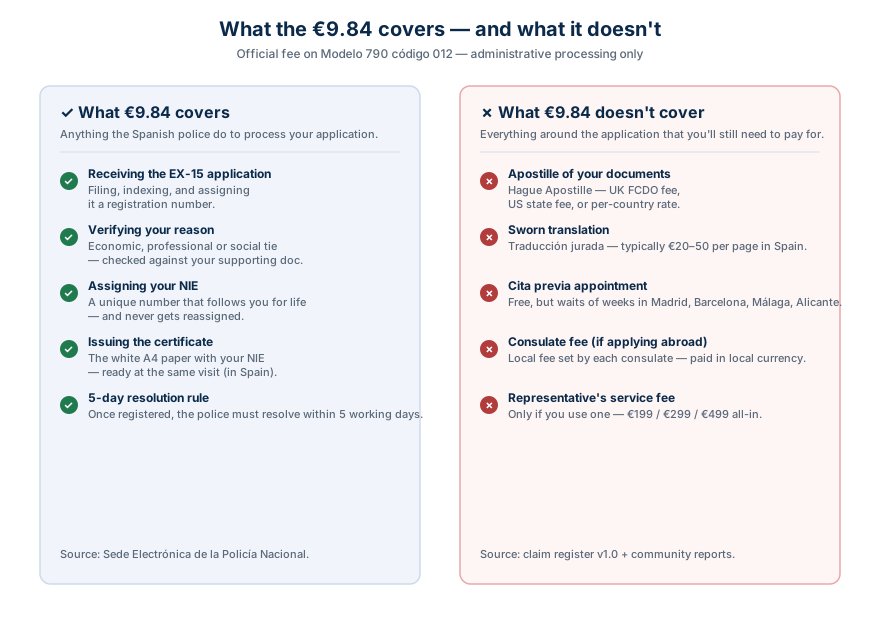
The fee is paid before you submit, not at the counter, and it is paid directly to the state through a bank — no intermediary is part of the official chain.
- Download the 790/012 form from the official portal — the form itself is free.
- Tick the concept "Asignación de Número de Identidad de Extranjero (NIE) a instancia del interesado" — and only that line.
- Pay €9.84 in cash or by card at any banco colaborador (practically any Spanish high-street bank).
- Keep the machine-stamped form. The bank validates it with a stamp — that stamped paper is your proof of payment, and no office accepts the application without it.
Applying through a consulate? The consular fee is paid locally at the consulate's own rate instead.
Form 790/012 covers many different procedures, and the concepts sit next to each other on the same page. Do not pay the wrong line:
| Concept on the 790/012 | Fee | This is for |
|---|---|---|
| Asignación de NIE | €9.84 | The NIE itself — this page |
| TIE, first issue | €16.08 | The physical residence card, first time |
| TIE, renewal | €19.30 | Renewing the residence card |
| Larga duración card | €21.87 | Long-term residence card |
| Certificado de registro UE | €12.00 | The EU citizen green certificate |
Paying €19.30 "to be safe" does not buy you a better NIE — it buys you a rejected proof of payment and a second trip to the bank. The concepts are not interchangeable, and the difference between the documents is exactly the subject of NIE vs NIF vs TIE vs DNI.
Justifying your reason (the motivo)
The legal standard comes from Real Decreto 557/2011: the applicant must document the economic, professional or social causes behind the request — the justificación del motivo. "I would like a NIE" is not a reason; a document is. What offices accept in practice:
- Economic: a property reservation or purchase contract (contrato de arras), a bank's letter for a mortgage or account, inheritance acceptance paperwork, a vehicle purchase agreement.
- Professional: a job offer or employment pre-contract, a company incorporation deed naming you, registration paperwork for self-employment.
- Social: university enrolment, family circumstances documented in civil registry certificates.
Documents issued abroad need an apostille under the Hague Convention of 5 October 1961 and, where not in Spanish, a sworn translation. One good document beats three vague ones: the examiner needs to map your ticked motivo to a paper that proves it.
Passport and address
Bring your passport and a full copy — every page, including blanks, is the safe reading; some offices accept the data pages only, none accepts fewer. EU citizens can use their national ID card instead. For the address, the rule bears repeating because so many guides get it wrong: no empadronamiento required. The NIE is granted on the strength of your reason, not your address, and a foreign address on the EX-15 is fine — the NIE is not a residence permit and does not assume you live in Spain.
What you do NOT need
- ✗ Empadronamiento. Town-hall registration is not on the EX-15 document list. Anyone requiring a padrón for a NIE is describing a different procedure.
- ✗ A Spanish address. Notifications can go to your address abroad, or to your representative's address in Spain.
- ✗ Your personal presence — if you appoint a representative. With a notarised, apostilled power of attorney under Ley 39/2015, the whole file can be submitted and collected without you entering Spain.
- ✗ Photographs. The white NIE certificate carries no photo; photos belong to the TIE card procedure (EX-17), not this one.
- ✗ A translation of your passport. The passport is accepted as is; translations are only needed for the supporting documents that justify your reason.
⚠ Scams to avoid
- ✗ "Pay the tasa online through us." The 790/012 is paid directly at a banco colaborador in Spain, and the amount is €9.84. A site collecting the "tasa" online with a mark-up is charging you a private fee for a payment you (or your representative) still have to make at a bank.
- ✗ Selling the EX-15 or the 790/012 form. Both forms are free downloads from official portals. Anyone charging for the blank paperwork is charging for nothing.
- ✗ "You need a padrón package first." Empadronamiento is not on the EX-15 document list; a bundled "padrón + NIE" offer adds a requirement the procedure does not have.
Frequently asked questions
How much does a Spanish NIE cost?
The official fee is €9.84, paid on Modelo 790 código 012 under the concept "Asignación de Número de Identidad de Extranjero (NIE) a instancia del interesado". Anything above that is a service charge, not a government fee.
What forms does a NIE application need?
Three pieces: form EX-15 (Solicitud de NIE) signed in two copies, the €9.84 fee paid and stamped on Modelo 790 código 012 at a banco colaborador, your passport + proof of your economic, professional or social reason under Real Decreto 557/2011.
Can I pay the NIE fee from abroad?
The 790/012 is paid at a Spanish banco colaborador. If you apply through a consulate, you pay the consulate's local fee in local currency instead. If you apply through a representative, they pay €9.84 in Spain as part of filing your application.
Do I need the empadronamiento to get a NIE?
No. Empadronamiento (town-hall registration) is not on the EX-15 document list, and a foreign address on the form is acceptable for notifications. The NIE is not a residence permit and does not require Spanish residence.
What counts as proof of my reason for needing a NIE?
A document matching the motivo you tick on the EX-15: a purchase contract or arras, a job offer, a company incorporation deed, enrolment papers, a bank or notary letter. It must be current, name you, and if issued abroad carry an apostille (Hague 1961) and a sworn Spanish translation.
What documents do I NOT need?
You do NOT need: empadronamiento, a Spanish address, photographs (those go on the TIE card, not the NIE), a passport translation, or personal presence at the police station if you use a POA representative under Ley 39/2015.
What's the difference between the 790/012 concepts?
Same form, different procedure lines. NIE = €9.84. TIE first card = €16.08. TIE renewal = €19.30. Larga duración card = €21.87. EU registration certificate = €12.00. Tick the wrong line and your proof of payment is invalid.
Related guides
Sources
- Sede Electrónica de la Policía Nacional — Asignación de NIE (form EX-15, document list)
- Sede Electrónica de la Policía Nacional — Tasas administrativas (€9.84 / €16.08 / €19.30 / €21.87 / €12.00)
- Real Decreto 557/2011, Art. 206 — Reglamento de Extranjería (motivos)
- Ley 39/2015, Art. 5 — Poderes de representación administrativa
- Hague Convention of 5 October 1961 — apostille standard
Reviewed by the Happy Residence S.L. team. Forms, fees and procedures reflect the current Sede Electrónica documentation; specific offices may interpret the rules differently. We re-verify after each regulatory change. We are an administrative assistance service, not a public administration.